How to Build a Pitching Machine

By eHow Contributing Writer

When you need to work on your baseball batting technique, but don't have a pitcher available, you need your own batting machine. Purchasing commercial versions of batting machines can be expensive, but it is possible to make your own. All you need is a few power tools and a lot of ingenuity.

    Build the Base

  1. Step1

    Screw the two pieces of 6-inch-long 2x6's to the upper left and right corners of the plywood. Place at least two wood screws through the plywood and into the vertical pieces of 2x6.

  2. Step2

    Lay the 3 foot long piece of 2x6 across the tops of the upright 2x6 posts and screw them down using the wood screws.

  3. Step3

    Place the four tire jacks under the legs of the coffee table on a flat surface. Raise the jacks to approximately waist height. Use a carpenter's level to ensure that the table is level.

  4. Step4

    Set the plywood and 2x6 frame on the table.

  5. Set Up the Motor and the Feed Chute

  6. Step1

    Use one of the electric drills to drill two holes in 3-foot piece of 2x6. These holes should be moderately larger than diameter of the axles and placed approximately 11 inches apart.

  7. Step2

    Thread a nut and lock washer up the axle.

  8. Step3

    Place the two wheel barrow tires under the holes. Thread them onto the axles and use an additional lock washer and nut to firmly hold them in place. You will need to tighten both nuts and washers around the wheel hub.

  9. Step4

    Screw the 2x2 pieces to either side of the 2x6 where the axle rises out of the board.

  10. Step5

    Center the short piece of plumbing drain hose at the opening between the two wheel barrow tires and screw it into the plywood.

  11. Step6

    Securely affix the drills to the visible ends of each axle. The drills should be facing into each other, so that when they are turned on, they will rotate the wheel barrow wheels at the same speed, in opposite directions.

  12. Step7

    Drop a baseball down the drain hose and watch it fling out from between the tires. Your now ready to start pitching your first baseballs with your home made pitching machine.

Red Sox' Top 10 Defining Moments of the Decade

by Jessica Isner on Jan 1, 2010 10:26:31 AM

Ten years ago, the Red Sox were losers.

My, how times have changed.

The last decade -- save for a few gut-wrenching moments (but not nearly as gut-wrenching as the defining moments of decades past) -- has been good to the most tortured, most unlucky, most cursed team in the history of baseball. It has been a decade of change for a team that couldn’t win a championship for 86 years but somehow managed to win two in the span of four years. It has been a decade that has seen a team spend well (most of the time), bring in the proper pieces for a championship puzzle (most of the time), and combine those players with homegrown superstars in order to produce a title for a city that never thought it would ever see the day.

During a decade in which the identity of everything Red Sox was drastically altered, it’s hard to pinpoint just 10 defining moments, but here are the most important, most crucial, most critical moments that shaped the current-day Red Sox -- the anti-losers. Finally.

10. Red Sox learn how to cultivate homegrown talent
If you look at some of the most instrumental players in the Red Sox’ success over the last 10 years --Jonathan Papelbon, Kevin Youkilis, Dustin Pedroia, Jacoby Ellsbury, Jon Lester, Clay Buchholz, etc. -- they all have something in common: They all came up through the Red Sox' system. This is a tribute to the Red Sox’ scouting and development team; in the last decade, they’ve been able to pinpoint what it is that can accurately project a player’s chances for success in the majors. They’ve been able to identify talent when they see it, and they’ve been able to groom that talent in the minor league ranks until it is good and ready to debut at Fenway Park.

It also proves that the Red Sox haven’t been trigger-happy in dealing their prospects to other teams (except for one infamous case, but we’ll get to that later). Boston’s reluctance to trade away its premier talent has paid dividends, and let’s hope this is a trend that continues for the next 10 years.

9. Red Sox trade Hanley Ramirez for Josh Beckett, Mike Lowell
In the 2005 offseason, after the Red Sox were embarrassed in the first round of the playoffs by the eventual champion White Sox, the front office (sans Theo Epstein, who resigned for a little while) got right down to business. The brass knew it had to bring in a stud pitcher if the Red Sox had any hope of competing for a second world championship, and that’s where Josh Beckett came in.

Beckett -- who became the youngest World Series MVP ever at age 23 when the Marlins won it all in 2003 -- came to Boston in a package with Guillermo Mota and Mike Lowell. Florida reportedly would not trade Beckett unless the team agreed to take on Lowell and his massive salary – and with Lowell coming off a year in which he hit .236 with eight homers and 58 RBIs, the idea of paying him $9 million was unappealing, to say the least.

Of course, Beckett and Lowell would become the two biggest components in Boston's World Series run in 2007. Beckett finished the postseason with a 4-0 record and a 1.07 ERA, and Lowell was named World Series MVP after hitting .400 in the four-game sweep.

The downside is that the move cost the Red Sox Hanley Ramirez, who easily could’ve been one of the best shortstops in Red Sox history. In 2009, the former Rookie of the Year hit .342 with 24 homers and 106 RBIs.

Was the trade worth it? That debate isn’t likely to end anytime this decade.

8. Red Sox fire Grady Little, hire Terry Francona

Grady Little’s fate as the manager of the Boston Red Sox was sealed on the evening of Oct. 16, 2003, when he did not pull an obviously gassed Pedro Martinez in the eighth inning of Game 7 of the ALCS against the Yankees. The Red Sox blew a 5-1 lead in the eighth inning and ended up losing the series, and just a few days later, Little was done.

Then, in stepped Terry Francona. The former Phillies manager didn’t have much on his resume in terms of success at the helm of a major league ballclub, but something about him clicked in the Red Sox clubhouse. Perhaps it was his reputation as a player’s manager that earned his team’s unwavering trust; perhaps it was his refusal to air any of his grievances with the media; perhaps it was his self-effacing but somehow self-assured demeanor. His aw-shucks attitude doesn’t sit well with all of Red Sox Nation, but the numbers show it works: In five seasons with the Red Sox, he led the team to a 565-407 record, two World Series championships and four playoff berths. Under Francona, Boston has finished with fewer than 95 wins just once.

Francona was rewarded with a three-year extension in the 2008 offseason that will keep him in Beantown through 2011.

7. Jon Lester, Clay Buchholz throw no-hitters at Fenway Park

The feel-good moments have been quite abundant for the Red Sox in the last 10 years, but there is little that felt as good as watching two of Boston’s homegrown talents accomplish one of baseball’s most respectable feats within eight months of one another.

Buchholz’s accomplishment was special -- the then-23-year-old no-hit the Baltimore Orioles on Sept. 1, 2007, becoming the third pitcher since 1900 to throw a no-hitter in his first or second major league start -- but Lester’s left Fenway Park without a dry eye in the house. The 24-year-old was just 14 months removed from a bout with non-Hodgkins lymphoma when he silenced the bats of the Kansas City Royals on May 19, 2008. Red Sox fans and sports fans alike were all rooting for him, but nobody expected his story to take this kind of extraordinary turn. It was the first no-hitter by a lefty in Red Sox history since Mel Parnell did it more than 50 years earlier, but it was undoubtedly the most poignant no-hitter the franchise has ever seen.

Since then, Lester has cemented himself as Boston’s ace of the future, a workhorse, a strikeout machine and a staple in the history books.

6. The Manny signing and the Manny trade
It’s hard to pin the hopes and dreams of a franchise on one player’s shoulders -- unless that player isManny Ramirez. Former GM Dan Duquette signed the perennial slugger to a monstrous eight-year, $160 million deal on Dec. 13, 2000, giving the city of Boston the one thing it yearned for: a bona fide slugger who was exciting enough to fill up the ballpark, to give fans someone to love and cherish and immortalize.

Ramirez’s tenure in Boston was characterized by ups and downs. Half the time, the city hated him for sitting out critical games against the Yankees, for appearing to dog it on the basepaths, for claiming he wanted to be anywhere but here. For the other half, though, the city adored him. He was a lovable goofball who could drill a ball onto Landsdowne Street with more authority than any other hitter in his generation. He kept things entertaining with his infamous outfield gaffes. He had funny hair and he said funny things.

Of course, it all turned sour in 2008, when Theo Epstein & Co. came to the conclusion that the team chemistry would suffer irreparable damage unless Ramirez was sent elsewhere. So on July 31, he was sent to Los Angeles in exchange for Jason Bay in a deadline blockbuster deal. The numbers show that the Red Sox’ offensive production hasn’t suffered as a result -- it actually has improved -- but it certainly feels like something is missing (and David Ortiz would probably attest to that, too).

The Red Sox may never see another hitter of Manny’s caliber, so let’s choose to remember him for the good times, shall we?

5. Larry Lucchino, John Henry and Tom Werner buy Red Sox, hire Theo Epstein
The latest Golden Age for the Red Sox began in 2002, when the team was sold to New England Sports Ventures, headed by John Henry. Tom Werner became the executive chairman of the team, and Larry Lucchino served as president and CEO. One of the first moves on the agenda was firing Dan Duquette and manager Joe Kerrigan, hiring Grady Little, and -- one year later -- hiring a 28-year-old Yale kid named Theo Epstein as the youngest GM in MLB history.

Since 2003, the Red Sox’ growth has been astounding. They have missed the postseason just once, they’ve won those two World Series and they have completely changed their philosophy for evaluating talent. Epstein’s strategies -- many of which are borrowed from the Moneyball king himself, Billy Beane -- revolve around paying for solid defense and solid pitching, and patching up offensive holes with cheap players who have large upsides. Sometimes this works out well (see: 2004), and sometimes it kind of backfires (see: 2008, 2009). But one thing Red Sox Nation has never questioned since the new ownership group took over is whether the team is in good hands.

After all, how can the Nation argue with a group that brought Boston its first championship in 86 years?

4. The 2007 World Series
The year 2007 was the year the transformation of the Red Sox identity was solidified. A team that had once been characterized by its lovable loser-ness won its second championship in four years. Some even began discussing the possibility of a dynasty. These were no longer your grandfather’s Red Sox.

The 2007 squad was led by the same core as the 2004 team -- Manny Ramirez and David Ortiz led the offensive charge -- but few key offensive acquisitions paved the way for success in the playoffs. One was Dustin Pedroia, the eventual Rookie of the Year who rebounded from a horrendous start to hit .317 with eight homers and 50 RBIs. The spunky second baseman was no slouch on the diamond, either, submitting a .990 fielding percentage, and he characterized the new mentality of the Red Sox: gritty and hard-nosed with a team-first, me-later mentality. Mike Lowell also had a bounceback season, hitting a career-best .324 with 21 homers and 120 RBIs, and in his first year in Boston, the much-maligned J.D. Drew temporarily quelled the fury of Red Sox Nation with one particularly notable grand slam in Game 6 of the ALCS against Cleveland.

After winning the AL East for the first time since 1997, Boston swept the Angels in the ALDS for the second time in four years before falling into a tantalizing hole in the ALCS. This time, after trailing Cleveland 3-1 in the ALCS, the Red Sox rode Josh Beckett’s fastball all the way to a seven-game series win and swept the red-hot Rockies in the World Series.

3. The Heavyweight Battle: Jason Varitek vs. Alex Rodriguez
It’s hard to pinpoint one moment in the past 10 years and say, “This is when everything changed” -- unless it’s this moment. If you had to pick one image to commemorate the Red Sox’ journey through the last decade, it would be this one. (Or maybe this one. No?) I firmly believe that had Jason Varitek not punched Alex Rodriguez in the face on July 24, 2004, the Red Sox would not be what they are today. That moment cemented the Red Sox’ legacy.

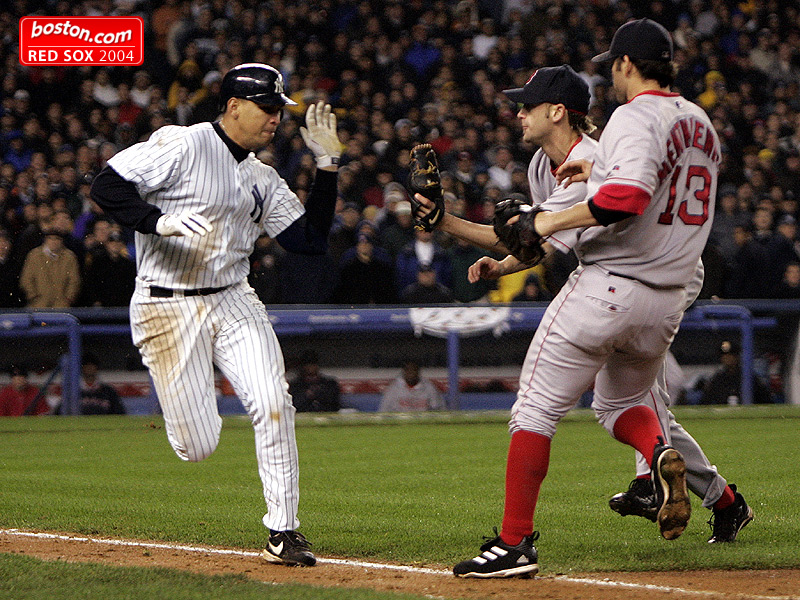
The game probably shouldn’t have been played in the first place -- it had been pouring rain all day -- but after a 54-minute delay, the Red Sox personally appealed to their manager and to the umpires and begged to get things started. The Red Sox were down 3-0 and hadn’t yet gotten a hit whenBronson Arroyo plunked A-Rod. A-Rod mouthed off and moved toward the mound, and when Varitek tried to interfere, A-Rod turned the fury on him. Varitek hit him and thus began one of the most memorable brawls in Red Sox history.

And there was still a game to be played.

Boston came from behind to take a 4-3 lead in the fourth, then went down 9-3, then came back to make it 9-8, then went down 10-8 in the seventh. By the bottom of the ninth, Mariano Rivera was on the mound, and the Red Sox were at risk of falling 10 1/2 games behind New York in the AL East. Then, in what would become Boston’s defining win of the regular season, Bill Mueller hit a two-run bomb off Rivera to carry Boston to an 11-10 victory.

The Red Sox of the future were born.

2. Red Sox lose to New York in Game 7 of 2003 ALCS
Every exhilarating win is accompanied by a debilitating loss.

Let’s get the loss out of the way first.

The 2003 Red Sox were a precursor to the 2004 Red Sox; they were spunky, they were laid-back and they talked about cowboys a lot. Theo Epstein’s debut team went 95-67 for a second-place finish in the East -- right behind New York, as usual. But during the playoffs, it became evident that something about this team was magical.

In the ALDS, the Sox fell into a 2-0 hole against a stellar Oakland pitching staff that featured Mark Mulder, Barry Zito and Tim Hudson. Everything changed very early on the morning of Oct. 5. That’s when Trot Nixon hit a two-run walkoff home run off Rich Harden in the 11th inning to keep the series going. Somehow, Boston prevailed in five games and earned a date with the Yankees in the ALCS.

The ALCS went back and forth between the two teams and was punctuated by typical Red Sox-Yankee drama -- spats between Roger Clemens and Manny Ramirez, brawls between Pedro Martinez and 72-year-old bench coaches. You know, the usual.

By the middle of Game 7 at Yankee Stadium, the Red Sox looked like they were headed for their first World Series appearance since 1986. It was the eighth inning, Boston held a 5-2 advantage and there was one out. Then, Derek Jeter doubled to right. Bernie Williams singled to center. Hideki Matsui hit a ground-rule double and one run scored. Would Martinez come out? Of course not. Once he surrendered a bases-clearing double to Jorge Posada and coughed up the entire lead, though, he headed for the dugout.

Everyone knows what happened then. Extra innings. Aaron Boone versus Tim Wakefield. Bye bye, Red Sox.

But the next year …

1. Red Sox win their first championship since 1918
First, Theo Epstein convinced veteran ace Curt Schilling to waive his no-trade clause to come to Boston and win a championship. Then Varitek punched A-Rod. Then Epstein traded away Nomar Garciaparra -- the face of the organization -- and picked up three guys that not many folks in Boston had ever heard of: shortstop Orlando Cabrera, first baseman Doug Mientkiewicz and utilitymanDave Roberts. All of the pieces were almost in place.

The Red Sox were expected to do some damage in the 2004 postseason; they had a pitching staff led by Schilling and co-ace Pedro Martinez, they had a record-setting offense led by David Ortiz and Manny Ramirez, and they swept the Angels out of the first round before aiming to pin some revenge on the Yankees for the 2003 debacle.

Things didn’t really go as planned. The Red Sox fell into a 3-0 hole, Schilling unveiled an ankle injury that could have KO'd him for the rest of the postseason and the offense was dead asleep.

Then came pretty much every moment the Red Sox are now famous for.

Kevin Millar walked. Dave Roberts pinch-ran and stole second. The Red Sox tied two straight games off legendary Yankees closer Mariano Rivera. David Ortiz single-handedly sustained the series with walkoff hits in Games 4 and 5. The world got its first glimpse at Schilling's bloody sock. A-Rod tried to slap the ball out of Bronson Arroyo’s glove in Game 6. Derek Lowe clinched Game 7 on the turf of Yankee Stadium. The Yankees watched from their own home dugout as Boston celebrated its first trip to the World Series in almost 20 years.

Oh yeah, then the Red Sox swept St. Louis for the title.

For the first time since the early 20th century, this decade’s story has a happy ending.

***


Veteran coach Charlie Williams passes away

By Cody Thorn
Posted Dec 17, 2009 @ 12:03 PM
Last update Dec 17, 2009 @ 12:26 PM

Veteran basketball coach Charlie Williams and his College Heights Christian basketball team picked up its first win of the season against Frontenac, Kan. on Tuesday, Dec. 8.

Sadly, it turned out to be the last game he ever coached.

Williams, a long-time college coach, passed away at the age of 67 Tuesday night at Freeman Hospital in Joplin. He leaves behind his wife of 30 years, Kim, as well as three children, Chuck, Trish Gage and Cody, and one grandson, Gaven.

Williams is mostly known in this area through his 20-year run as head coach and athletic director at Ozark Christian College in Joplin. In his time there he served as, at various times and sometimes concurrently, as head coach of boys basketball, girls basketball, volleyball, soccer and baseball.

He also coached at Midwest Christian College in Moore, Okla., prior to coming to Joplin in 1985. After leaving OCC, he worked for Missouri Southern’s and Crowder’s women’s basketball programs, before becoming a coach at College Heights Christian in Joplin. This year he was the head boys basketball coach and stepped in as athletic director.

He had a heart attack last Wednesday and another the next day and was admitted to the hospital. After leaving ICU this past weekend and getting a room, the prognosis was good.

“We were told there was only mild damage and he could life a normal life and but he said I guess I can’t coach again,” said his son Chuck, currently the head boys basketball and football coach at McAuley.

Chuck was at junior high basketball practice when he was notified his dad had a third heart attack – this one fatal. He got to the hospital only minutes after his father died, at 8:50 p.m. on Tuesday night.

“It doesn’t seem real at all,” Chuck said. “There is so much more I could say, but I can’t express it right now.”

The funeral plans were made Wednesday and Chuck was racking up cell phone minutes and text messages. And then, there were the messages posted on his Facebook page.

“It’s good to see the impact he had in many lives,” Chuck said.

Chuck’s McAuley team is supposed to play Friday, but he won’t be there, as the game is the same time as his father’s visitation at College Heights. (The funeral is Saturday at 10 a.m. at the same location.)

Right now, though, coaching basketball is not on the forefront of his mind.

“The whole reason why I’m coaching is because of him,” Chuck said. “He is the reason I love basketball.”

This year was going to be a big one for the Williams family. On Jan. 26, the ‘Father-Son’ game was schedule when McAuley played College Heights. The two were supposed to play last year, but the game was canceled because of bad weather.

“I never got the opportunity to coach against him,” Chuck said, fighting back tears. “Which is probably good because he would’ve beaten me. He is a way better coach then I will ever be.”

After talking with Chuck, I also talked to a few other people I knew had ties with Charlie, either from playing for him or coaching with him or against him.

Bob Coffey, Seneca girls head basketball coach and former OCC assistant coach.
“Charlie was a wonderful mentor. He was the model of organization and professionalism. My thoughts and prayers go out to his family.

“I spent four wonderful years with Charlie, not counting the camps I helped with. The thing I got, first and foremost, is keeping the things that are important first and that was how to treat people. He went above an above and beyond and then, there was a little bit of basketball after that.

“He (Charlie) has probably forgotten more basketball than I will ever know. I marveled at how he organized his practices. I watched him work his program and I noticed all the little things. I never knew things that happened behind the scenes. He did everything from equipment and apparel ordering, to how to treat the officials and make them welcome when they come to your place. He was first class.”

“I was shocked when I found out. I had tried to contact Charlie last week. I saw his score in the paper and I saw they won their first game and I wanted to congratulate him and call and talk. He came here in August to speak to my team about goal-setting and teamwork. When I saw that in the paper it struck a nerve I needed to call him. I hadn’t heard from him. I called him a couple of times Wednesday and then again on Thursday. I was at practice Thursday when he sent a text message. It was incomplete. It said something about his son coming to pick him up. Becky called and said Charlie had a heart attack. I was afraid something was up. I was able to go see him Saturday and he looked great. I spent about a half hour and had a good visit. He texted me Tuesday and said he had a couple of good test results. I presumed he would be home in a few days. He talked to me about seeing one of our games.

“Charlie was there for me when my mother passed and my wife last year. Charlie was right there. I can still see him at my mother’s funeral. He made the four hour trip by himself to be there for me. It is all about taking care of people. That is what was important for him. I think the four states not only lost a great basketball coach, but a great person.”

Becky Land, Seneca JV coach and OCC basketball player, 2001-2005

“I would say the think I remember is how he acted like a father-figure for the girls on the team. Most of them were from out-of-state and he definitely took that role. He made sure to care of us and he treated us like his own children. One thing he always emphasized is loyalty. That is what I remember him saying over and over to the team. Is stay loyal to your friends, to your teammates, to whoever you are with.

“I definitely changed as a player. I was definitely intimidated to do much, but when I left I was more confident in my game. As a person, it’s the loyalty. He stuck by you even if you didn’t do thing right. He didn’t just say it, he showed you it.”

Josh Depoe, Neosho Junior High football and basketball coach and former OCC player, 2002-2004
“I got home from Nixa around 10:30 p.m. (Tuesday) and I had got a text. I was just shocked. I couldn’t believe it.

“He was the kind of coach that you wanted to succeed for. You wanted to do well for him. That is something I took away from playing for him. He empowered us to be better people and we wanted to succeed for him. He taught us not only basketball but to have a strong Christian walk as well.
“I remember at Christmas we would get Nike shoes that he bought himself. It wasn’t just basketball, you were part of his life.”

Jennifer Depoe, former Neosho High School girls coach and former OCC player, 1999-2003
“Let’s see … this will make me cry. As a person, he was such a great mentor. He showed me how to be dedicated in everything I did. He was loyal to the team and to the players. He was always there for you as a player. He made you want to work hard and he earned your respect. You wanted to do good for him.

“He always had a smile on his face everything I saw him. A lot of my coaching style was based on how he coached. He groomed me by being a player for him to being a coach. No matter whether we won or lost, he was proud that I did a good job.”

Derek Lahm, Carl Junction JV coach, former OCC basketball camp member
“I got a text from my dad at school today and he never text me. I was shocked to see my dad text me and then I read it …

“Coach Williams always took care of me every since I was little. I would go down to the camps when my dad would help. He would give me shirts and water bottles, he always spoiled me. He was a great man. He is leaving behind a great family. I’m shocked more than anything. He was a great man for the community and always had a top notch program at OCC. He was rebuilding College Heights into a solid program.

“He was always looking out for me and my family. I remember going camp at OCC and he paired me with Chuck, who was a senior and I was a freshman. We were in an air conditioned room. He took care of dad. He was a good man. My thoughts and prayers go out to his family. Trish was in my grade and Cody was younger, but I knew him too. I can’t imagine losing my dad. Charlie touched a lot of people. He was a good person.”

Robert Corn, MSSU basketball coach (posted on facebook)
“Charlie Williams was a class individual. We need more like him in the coaching profession. RIP my friend.”

Cody Thorn, sports editor
The passing of Charlie hit me rather hard because I have known him since I was 6 years old. The first year I moved to Carl Junction from Springfield, he was the head coach of my pitching machine league team. And that is where I formed a friendship with Chuck that still runs to this day.
There were so many memories I have of Charlie, from being Chuck’s dad to being the OCC coach. I remember many trips in their minivan to OCC games to watch the games. I can recall sitting underneath the baskets with a towel in a my hand to wipe up sweat off the floor like it was yesterday.

Perhaps the oddest encounter I have ever had, up to that point in my journalism career, came when I worked for the Joplin Globe. I had to go cover an OCC game and as a 20-year-old writer, I had to talk to Coach Williams. It was one of the few times in my life I never knew how to address a coach after a game. I had grown up the past 14 years, at that point, knowing him as Charlie and it was a little different in the more formal setting. I have since gotten used to it and in fact, having to talk to Chuck as a coach was perhaps more more different and difficult.

I will never forget how Charlie treated me and how many people’s lives he touched. I can think of hundreds of players I have watched play for him at OCC that went on to do great things in life. I see first-hand what a great job he did with his children. He was a many who loved sports. I can think of thousands of games over the years I looked up and saw Charlie sitting and watching a basketball game or baseball or even a golf tournament.

I’m going to miss talking with him and catching up. I am going to miss those phone calls asking me about coaching rumors and what I knew.

Perhaps what I will miss most is knowing that I could talk to a Hall of Fame coach anytime I wanted because he always had time for me.

Cody Thorn is the sports editor of the Neosho Daily News and can be reached at sports@neoshodailynews.com

Ecstasy in the Bronx! Yankees win title No. 27

By MIKE FITZPATRICK
AP Baseball Writer
Thursday, November 5, 2009 7:39 AM CST
NEW YORK (AP) — Paint the town in pinstripes! Nearly a decade after their dynasty ended on a blooper in the desert, the New York Yankees are baseball’s best again.

Hideki Matsui tied a World Series record with six RBIs, Andy Pettitte won on short rest and New York beat the Philadelphia Phillies 7-3 in Game 6 on Wednesday night, finally seizing that elusive 27th title — the most in all of sports.

It was the team’s first since winning three straight from 1998-2000.

“It feels better than I remember it,” Derek Jeter said. “It’s been a long time.”

Matsui, the Series MVP, powered a quick rout of old foe Pedro Martinez. And when Mariano Rivera got the final out, it was ecstasy in the Bronx for George Steinbrenner’s go-for-broke bunch.

What a way for Alex Rodriguez and Co. to christen their $1.5 billion ballpark: One season, one championship.

It certainly ended a lot better than it started — with a steroids scandal involving A-Rod, followed by hip surgery that kept him out until May.

“My teammates, coaches and the organization stood by me and now we stand here as world champions,” said Rodriguez, who admitted using steroids from 2001-03 while with Texas. “We’re going to enjoy it, and we’re going to party!”

For Chase Utley and the Phillies, it was a frustrating end to another scintillating season. Philadelphia fell two wins short of becoming the first NL team to repeat as World Series champions since the 1975-76 Cincinnati Reds.

Utley tied Reggie Jackson’s record with five home runs in a Series. But Ryan Howard’s sixth-inning homer came too late to wipe away his World Series slump, and Phillies pitchers rarely managed to slow Matsui and the Yankees’ machine.

“I told them that I loved the way they played. We’re fighters and never quit,” Philadelphia manager Charlie Manuel said. “We want to keep what we got as far as attitude and chemistry.”

In a fitting coincidence, this championship came eight years to the day that the Yankees lost Game 7 of the 2001 World Series in Arizona on Luis Gonzalez’s broken-bat single off Rivera.

Steinbrenner spent billions trying to win another Series. At long last, his team did.

Fittingly, it was dedicated to the 79-year-old owner, who has been in declining health and didn’t make the trip from his home in Tampa, Fla.

Still, his presence was felt.

“Boss, this is for you,” the giant video screen in center field flashed during postgame ceremonies while his son, Hal, the team’s managing general partner, accepted the championship trophy.

“The Yankees won. The world is right again,” team president Randy Levine said.

For the Four Amigos, it was ring No. 5.

Jorge Posada, Jeter, Pettitte and Rivera came up together through the minors and were cornerstones for those four titles in five years starting in 1996.

Now, all on the other side of age 35, they have another success to celebrate. And surely they remember the familiar parade route, up Broadway through the Canyon of Heroes.

“It’s an honor for me to win a championship with those guys. They are Yankee legends,” Mark Teixeira said.

But, hey, Babe and Yogi, Mr. October and Joltin’ Joe — you’ve got company. Teixeira, CC Sabathia and a new generation of Yankees have procured their place in pinstriped lore.

Moments after the final out, Joba Chamberlain and Nick Swisher led a victory lap around the warning track, carrying flags that read “2009 World Series champions.”

Players high-fived fans, then sprayed bubby behind the mound — the same sort of celebration Philadelphia enjoyed just last year after beating Tampa Bay.

“We think we can be back here again and again. We have a great squad,” closer Brad Lidge said.

New York wasted its chance to wrap things up in Game 5 at Philadelphia, then set its sights on clinching the World Series at home for the first time since 1999.

While nine years between titles is hardly a drought for most teams, it was almost an eternity in Yankeeland.

New York’s eight seasons without a championship was the third-longest stretch for the Yankees since their first one, following gaps of 17 (1979-95) and 14 (1963-76).

Jackson’s three homers in Game 6 against the Los Angeles Dodgers made the Yankees champs in ’77. On this November night, Matsui delivered a sublime performance at the plate that must have made Mr. October proud.

“It’s awesome,” Matsui said through a translator. “Unbelievable. I’m surprised myself.”

Playing perhaps his final game with the Yankees, Matsui hit a two-run homer off Martinez in the second inning and a two-run single on an 0-2 pitch in the third.

A slumping Teixeira added an RBI single in the fifth off reliever Chad Durbin, and Matsui cracked a two-run double off the right-center fence against lefty J.A. Happ.

A designated hitter with balky knees, Matsui came off the bench in all three games at Philadelphia. Still, he had a huge Series, going 8 for 13 (.615) with three homers and eight RBIs. His go-ahead shot off an effective Martinez in Game 2 helped the Yankees tie it 1-all.

Bobby Richardson was the only other player with six RBIs in a World Series game, doing it for the Yankees in Game 3 against Pittsburgh in 1960. Richardson had a first-inning grand slam and a two-run single in the fourth.

Matsui’s big hits built a comfortable cushion for a feisty Pettitte, who shouted at plate umpire Joe West while coming off the field in the fourth. Still, Pettitte extended major league records with his 18th postseason win and sixth to end a series.

The 37-year-old left-hander, pitching on three days’ rest, became the first pitcher to start and win the clincher in all three postseason rounds. He beat Minnesota and the Los Angeles Angels in the AL playoffs.

Pettitte lasted 5 2-3 innings, allowing three runs, four hits and five walks. Chamberlain and Damaso Marte combined for 1 2-3 innings of scoreless relief before Rivera secured the final five outs.

“You don’t look at it as a failure,” Howard said. “We had a great season. We just got beat by the better team.”

It had been nearly a half-century since players had won five titles with one team. The last to do it? Of course a bunch of Yankees: Yogi Berra (10 titles), Mickey Mantle (seven) and Whitey Ford (six) in 1962, according to STATS LLC.

For second-year manager Joe Girardi, a three-time Yankees champion as a player, it was the fulfillment of a mission. When he succeeded Joe Torre in October 2007, Girardi chose uniform No. 27, putting his quest on his back for all to see. His tenure didn’t start out so well, with New York missing the playoffs in its final season at old Yankee Stadium following 13 consecutive appearances.

Star power: Phillies, Yankees set for World Series

By BEN WALKER
AP Baseball Writer
Wednesday, October 28, 2009 10:45 AM CDT
NEW YORK (AP) — All-Stars at most spots, mixed in with MVPs and Cy Young winners. A rich roster, full of World Series success.

So how come the defending champion Philadelphia Phillies are such underdogs?

Probably because they’re facing the team that has defined championship baseball for so long.

Derek Jeter, Mariano Rivera, Andy Pettitte and the New York Yankees, hoping to include Alex Rodriguez in a full-throttle celebration this October.

A pair of franchises separated by a 90-minute ride on the New Jersey Turnpike, with no real rivalry to speak of despite their century-long histories.

That could all change starting Wednesday night. Ryan Howard, Jimmy Rollins and the Phils are set to dig in against CC Sabathia in Game 1 at Yankee Stadium.

“I think the fact that we’re playing the Yankees and it’s close to Philadelphia and how the fans and the media react to it and how both cities look forward to it, that puts more icing on the cake,” Phillies manager Charlie Manuel said Monday. “It does something for the game.”

The Phillies worked out at Citizens Bank Park before hopping an Amtrak train for the hour-plus trip to Penn Station in midtown Manhattan. Whether they ride back up next week will be decided later — none of the last five World Series has lasted more than five games.

In the meantime, all aboard!

How much of the country will tune in to the all-Northeast matchup remains to be seen. The folks in Las Vegas already have taken a look — in spite of the Phillies’ credentials, the Yankees are heavy 2-to-1 favorites.

Philadelphia is trying to become the NL’s first repeat champion since the 1975-76 Big Red Machine in Cincinnati. The Yankees return to the Series for the first time since 2003, having last won in 2000.

Cliff Lee opens for the Phillies, hoping to continue their run that includes a five-game romp over Tampa Bay in last year’s World Series. At 16-4, Philadelphia has assembled the best record over a 20-game span by an NL team in postseason history.

Manuel hasn’t shown any tendency to pitch around opposing sluggers, so Lee, Cole Hamels and Pedro Martinez figure to challenge Rodriguez from the get-go. A-Rod hit .438 with five home runs and 12 RBIs through the playoffs. This is his first foray into baseball’s big event.

“A lot of great players have never had the opportunity to play in the World Series,” Rodriguez said Sunday night after the Yankees’ clinching win over the Angels in Game 6 of the AL championship series.

“It’s been a dream of mine since I was a 5-year-old boy to play in the World Series. In order to win the World Series, you have to get there and we’ve done that now,” he said.

It’s a power-packed matchup, marking the first time since 1926 the World Series pits the teams that finished 1-2 in the majors in home runs, according to STATS LLC. Back then, Babe Ruth and the Yankees led with 121, followed by St. Louis with 90.

This year, Mark Teixeira and the Yankees hit 244 and the Phillies tied with Texas at 224.

Add in two homer-friendly parks, along with the teams that led their leagues in runs, and runs could flow. Then again, everyone knows that pitching rules the postseason — neither Manuel nor Yankees manager Joe Girardi has announced his plans, though New York seems to be leaning toward a three-man rotation of Sabathia, A.J. Burnett and Pettitte.

But what about Brad Lidge? A postseason star last year, the Phillies reliever was a bust this season. That is, until this October — he was the only closer in the playoffs who did not give up a run.

Also worth watching: the forecast.

After last year’s World Series ended with a game suspended two days because of rain, more wet weather might be on the way.

AccuWeather.com said a storm was headed toward the Bronx and predicted rain and temperatures in the mid-50s for Game 1, with the drizzle possibly lingering for Game 2 Thursday night.

The first World Series game at the new, $1.5 billion Yankee Stadium will be played across the street from the old ballpark, where a record 26 championship banners flew.

“There’s definitely a special mystique when you walk into Yankee Stadium, new or old,” Phillies outfielder Jayson Werth said. “It’s the cathedral of baseball, where everybody wanted to play as a kid.”

AP Sports Writer Rob Maaddi in Philadelphia contributed to this report.

Michael Vick doesn't sound so thrilled about being an Eagle

While being really, really careful not to say anything that would make waves, Philadelphia Eagles"quarterback" Michael Vick(notes) said yesterday that he's not thrilled about his role in the Philadelphia offense.He doesn't dig the Wildcat, and if it's up to him, he won't be doing it next year.

"It would be hard," Vick said of returning to the Eagles, according to excerpts released by NBC. "It would be an everyday struggle. But I would have to take that time to hone my skills and get better. I'm excited about the opportunity I have moving forward whether it's with Philadelphia or another team." [...]

"I won't be a Wildcat guy. I can't," Vick told NBC. "It's a different style of play. It's almost like a hit-or-miss type of thing. My position is quarterback. That's what I was born to do."

What he does next year isn't really up to Vick, though. The Eagles have the option to keep him around next year for $3.6 million, though it's got to be seen as unlikely that the Eagles would pay that much for a guy whose only function seems to be to prevent the offensive from functioning smoothly or with any rhythm.

Not that that's Vick's fault, mind you. That coach Andy Reid brings him to stall the offense periodically is Andy Reid's decision. Maybe Vick can't make plays anymore ... maybe he can't throw or run. If that is the case, though, might I present this crazy idea to Andy Reid: Stop putting Vick in the game.

Again, Vick wouldn't talk about specifics for next season, and just reiterated that he wants to help the Eagles win a championship. Tony Dungy wasn't shy about talking about potential future Vick destinations, though.

"I told Michael to just worry about this year," [Dungy] said. "It's technically up to Philadelphia. If they want him back, he has to stay there. If they don't, there are some teams looking for quarterbacks: Cleveland, St. Louis and Washington.

"But I think a dark horse is Buffalo. They talked originally. There was some communication there. I think that could be a good spot."

Buffalo. Interesting. The Bills did pretty much admit that they signed Terrell Owens(notes) for the "wow" factor, to increase their profile and make a splash with the media. Vick would certainly do that.

But it's way too early to be thinking about that. Except for Cleveland. Michael Vick, Dawg Pound ... we probably don't want to do that.

Other popular stories on Yahoo! Sports:
• NFL player gets into scuffle with opposing coach
• Notre Dame coach under fire after big upset
• Video: Fastest goal ever recorded in soccer match

Baseball Uniform

In 1849 the first official baseball uniform was worn by the Knickerbocker Baseball Club from New York. It was a simple uniform with a white flannel shirt, blue wool pants, and a straw hat.

150 years later you have the modern baseball uniform which is quite the fashion statement from the past. Brilliant colored double knit uniforms are made from synthetic fabrics. But what occurred from then to now?

Caps

Lets start with caps. Now and in the past the cap served many purposes including keeping the sun out of the players eyes and distinguishing players from fans. The distinctive team colors and logos also help promote the team spirit.

The first had appeared in 1849 and they were made of straw. A few years later the merino cap appeared which was made of wool and had the crown and visor still seen in modern caps.

The first team to place its nickname was the Detroit Tigers in 1901. This was the beginning of using the cap to identify teams. The last team to wear a cap without lettering was in 1945 and that was the St Louis Browns

Jerseys

The jersey first took its place back in the 1850s when jerseys really took of. The jerseys of the 1860s and 1870s closely resembled those worn by the volunteer fire departments. By the late 1870s the laced front jersey appeared and remained popular until the 1890s. By 1910 these shirts had completely disappeared.

The 1882 era is remembered for the baseball uniforms that have come to be called clown costumes. With the multi colored uniforms used to denote each position you can quickly imagine how lively the field must have looked. By 1888 many teams had begun to wear striped uniforms. They faded but then returned around 1907 and by 1915 they were standard issue.

The 1940s brought a new bold look in jerseys from the Chicago Cubs. They wore a lightweight flannel vest over a knitted shirt. It allowed for a nice range of motion.

The modern jersey is made of synthetic fabric that is breathable and allows for a excellent range of motion.

Baseball Pants

The baseball pant is paid the least amount of attention out of all the uniform pieces. They are not marketed to the fans and they attract plenty of interest. Today the style and length of pants varies more than any other period of league play.

The first baseball trousers worn in 1840 by the Knickerbocker Baseball Team were a blue wool pant. By 1880 additional padding had been added to the pants and remained popular for around 20 years.

Throughout the 19th century and into the first decades of the 20th century players wore their pants with stockings showing to the bottom of the knee. Then the trend was to lower the leg length referred to as the low roll. In the 1950s a longtime ump called for an end to the long pants.

By the 1990s the pant length had dropped to a length where the pant could be tucked into the shoe. In the 2000-2006 CBA for the first time uniform regulations were covered. There are seven regulations relating to pants and one of those limits the pant length to be no lower than the top of the shoe heel.

Baseball Stockings

The Cincinnati Red Stockings introduced knickers to the baseball field in 1868. This resulted in a quite a display of the players legs. Occasionally Wright would appear with wearing these scarlet stocking which soon caught on with other players.

Early stockings had quite a variety of colors and stripes and that stands even today. Depending on the team depends on the stocking style.

Baseball Shoes

There isnt a lot known about the earliest baseball shoes. The first all-leather shoe made available by Spalding was the calf skin League Club Shoe, first offered in 1882 for $6 per pair.

The introduction of artificial turf in the mid-1960s affected the baseball game. Synthetic grass also led to a changes in the baseball shoe. Metal cleats where abandoned in favor of a flat shoe. During the late 1970s, companies began manufacturing shoes designed for synthetic turf.

These soles were constructed with small rubber bumps across the sole, providing good traction while not damaging the turf. By the 1980s plastic cleats had been introduced. Both styles are still used today.

Baseball Logos And Numbers

Team logos, names, and numbers have adorned baseball uniforms as early as 1907 and this practice is still used today. How often do we actually refer to a player by their number rather than there name. Many people recognized their team by their logo long before they see the teams name. Dont expect this type of branding to disappear.